Water for the Birds

By Sandra Tuszynska

The ideal situation for any creature, is to live in a safe home, protected from predators, the wind, the sun and the rain, and to have an abundant supply of water and food near their home. Water is a necessary for life and birds like most other creatures rely on a daily supply of water for survival. All animals require water and food near their home. Just like we like to have a water source in our homes, so do animals need a source of water near their homes.

Water is a scarce resource in many parts of Australia and without water animals are forced to relocate their homes in search for this essential resource. Often when they do find water, there is no housing to be found. As much as 20% of our wildlife requires tree hollows to nest in, and since most of our old growth trees with hollows have been cut down for agriculture, they have no homes to live and breed in. So our bird and other wild life is definitely facing a survival crisis.

Red-backed Fairy Wren and White-throated Honey-eater

Red-backed Fairy Wren and White-throated Honey-eater

Challenging Climate

I live in a very dry environment of south-west Queensland in a region called the South Burnett, located north-west of Brisbane. It is called the “peanut country” but there are lots of cattle farms here too. There is very little tree cover and this means a dry climate. It has become drier and drier over the years. Sometimes it does not rain at all for over six months. However, when it does, it often comes down all in one go, creating serious flood damage. Many farmers commit suicide as a result of crop failure due to droughts and floods in the South Burnett region of Australia.

Our Bird Life

Surprisingly, there is still an abundant variety of birds here and I love to watch them and photograph them. The songs of the Butcher Birds and Magpies are like no other, the Cockatoos, Currawongs and Kookaburras are often my wake up call. The Double-barred Finches cry like baby kittens. The Pardalotes are as friendly as can be and the White-throated Honey eaters are just a delight to look at and listen to. I’ve had a family of King Parrots visit as well for quite some time and they are friendly and come up very close, these beauties are not shy at all. The male decided to sit on my computer once, hoping to get some food, once he emptied the bird feeder.

Red-backed Fairy-wrens

Red-backed Fairy-wrens

The sounds of the birds are so soul enriching for me and seeing them close, brings me joy and hope for a better tomorrow. Watching birds fly shows me the potential for my own freedom. I wonder how other people relate to birds?

The Bird Bath

I had bought hanging bird baths that seem to spill out a lot of the water that I add to them, so I have decided to experiment. I had this old flower pot saucer or a drip plate, that I once got at a market, a simple, round piece of plastic. I drilled some holes in it and threaded some wire through it, hanging it on a tree. It is not ideal in terms of access for birds to the water in it, as it does not have a gentle slope which is said to be kinder for the birds. However, it has a rim, which the birds can stand on and then bend downwards to drink from the shallow saucer. The depth of this plate is about 7 cm, so birds can simply stand in and splash without the possibility of drowning.

Double-barred Finch and White-faced Honey-eater

Double-barred Finch and White-throated Honey-eater

The way that the saucer is hung causes it to tilt to one side especially with the weight of the water or due to strong winds. So I do have to adjust the wire once in a while to keep it even so the water does not spill out of it constantly. It is obviously a very imperfect construction, which requires a little bit of maintenance, once in a while. Its also not very beautiful to say the least, however the birds do not seem to mind.

The Reward

I had no expectations as to whether the saucer will attract birds, I certainly had some hope though. It took a while for the birds to discover it, but once they did, they started to come regularly to have a drink and a bath in it. A family of White-throated Honey-eaters were the first to discover this new source of water.

White-faced Honey-eaters

White-throated Honey-eaters

First they stood on the edge and tilted themselves to the water. It took a while for them to trust that they are safe, but eventually they started to plunge themselves in and quickly go back to the edge. Eventually they took more risks and splashed a bit and even stood in the plate. These beautiful Honey-eaters are one of the most common users of the bird bath. A whole family of Double-barred Finches began to use the bird bath regularly as well.

Double-barred finches

Double-barred finches. A family gettogether

More often than not I have witnessed the Honey-eaters and the Finches drinking communally, they are not afraid of each other. So I have captured some photos of these two species coexisting and sharing the same water source.

Honey-eater and Finch

Honey-eater and Finch, splashing together

In the first week of January, there had been some extremely hot days. It was above 45°C and during one of these hot days, I recorded quite a few bird species visiting the bird bath. A Friar Bird, a Pied Currawong, Double-barred Finches, Red-backed Fairy-wrens, White-throated Honey-eaters, a Striped Honey-eater and possibly an Olive-backed Oriole. All of these birds came to cool off in the bird bath. All the birds had their beaks open, panting, trying to regulate their body temperature.

I have noticed that once the White-throated Honey-eaters or the Double-barred Finches arrive at the bath, other birds often follow. I was lucky enough to photograph these two species along with the Red-backed Fairy-wrens.
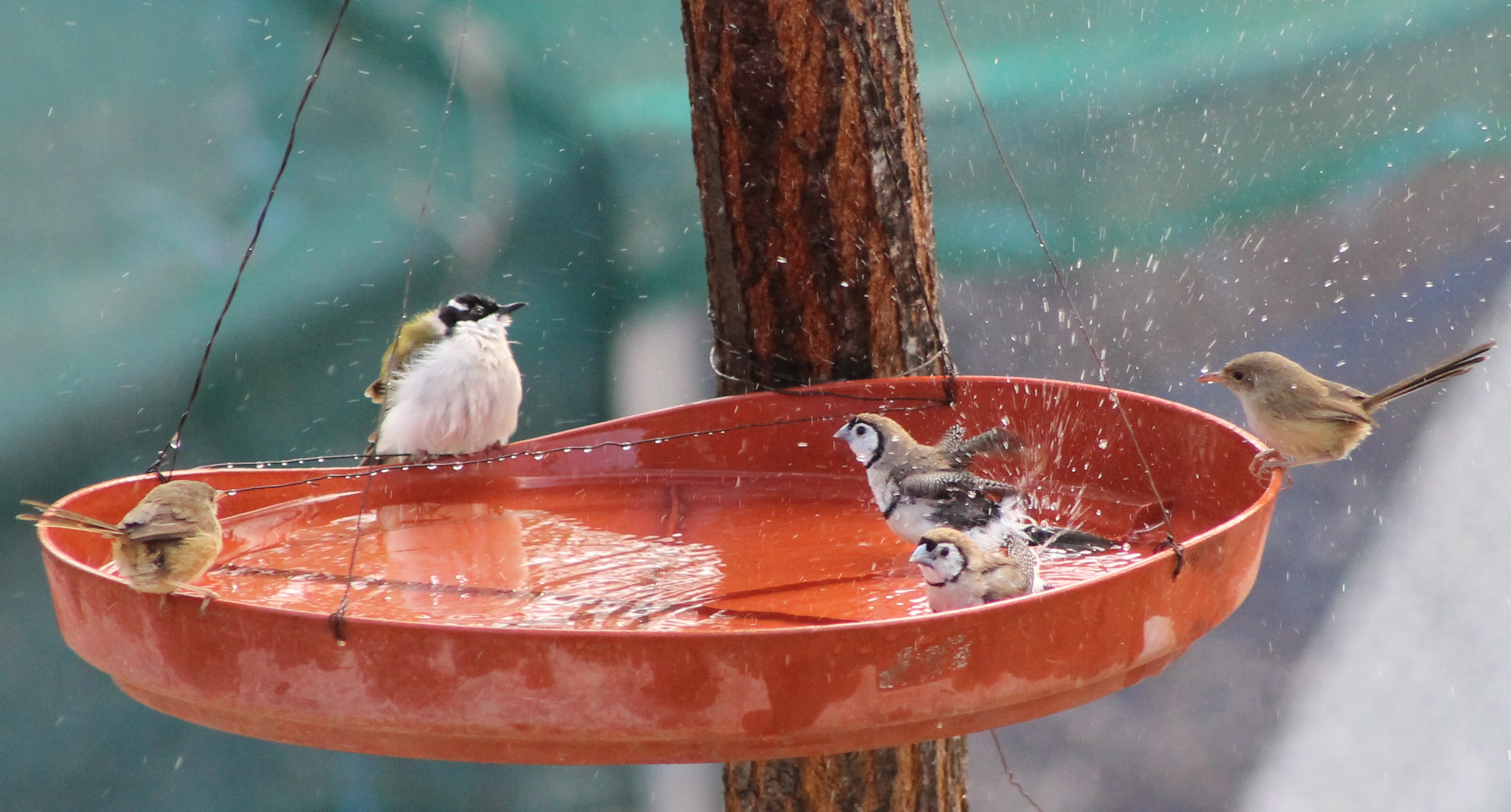
Finches, Honey-eater and Fairy Wrens

Finches, Honey-eater and Fairy Wrens taking a splash

It is as if they are watching one another and learning from each other. They are very happy to share with one another. It is really heart opening to see two or three different species of birds coexist, side by side, drinking and splashing together in as little as about a 30 cm puddle of water.

Cleaning the Bird Bath

It seems that the birds are not very fastidious when it comes to the cleanliness of their water. They just seem grateful that it is there, if in fact it is there. When I went away to the Woodford Folk Festival for a week, I felt very sad upon my return, knowing that the water must have dried out quite early in the week due to the extreme heat we’ve had.

I clean the bird bath almost as often as I replenish it, but I do it only when I really feel to do it. The frequency depends largely on the weather and the amount of water in the bath. Stagnant water in hot weather does develop algal growth. I simply clean it with my hands and swish fresh water through it. It is not at all difficult or time consuming to clean or replenish the bird bath. It brings me much joy to give my little friends some of this precious resource that water is, especially in this dry, water deprived environment. These little creatures bring me so much joy, it is the least I can do for them.

The Moral of the Story

For me, the pleasure of having birds around is indescribable and I find that new species continue to arrive to the land I live on. Recently a new visitor has arrived, the Satin Flycatcher.

Satin Flycatcher, a new and rare vsitor

Satin Flycatcher, a new and rare visitor

Some are transient visitors, while others, have made this land their home. The first thing that any living creature requires to survive is water. I have discovered that providing my flying friends a bit of water, I get to see them close up and take photographs of them which is a great reward for me.

Future Plans

My plan is to also provide housing for my little friends. I am lucky, I have friends that create bird and other wildlife homes and I have had the pleasure to get involved in the creative process. Many birds, especially parrots, and animals such as sugar gliders and possums, need tree hollows to nest and breed in. Most of old, hollowed trees have been cut down for agriculture, which means that many animal species have no homes to live in , the same can be said for their food supply, they are thus threatened with extinction.

King Parrots require deep tree hollows to nest in, which are rare in our environment

King Parrots require deep tree hollows to nest in, which are rare in our environment

I love having animals around me and to know that they are out there, they fascinate me. For these reasons I hope to create more habitat for them on the land I live on, this means installing nesting boxes and planting species of plants that insects and animals can benefit from. It is easy and enjoyable to create habitats for animals and there are numerous resources available today to help our animal friends live comfortable lives. The rewards are priceless.
Posted in Uncategorized | Tagged , , , , , , | 1 Comment

Summer storms to the rescue

WP_20140107_003

Prepared for hot dry summer – thick mulch

By: Sheamus O’Connor

WP_20140107_002

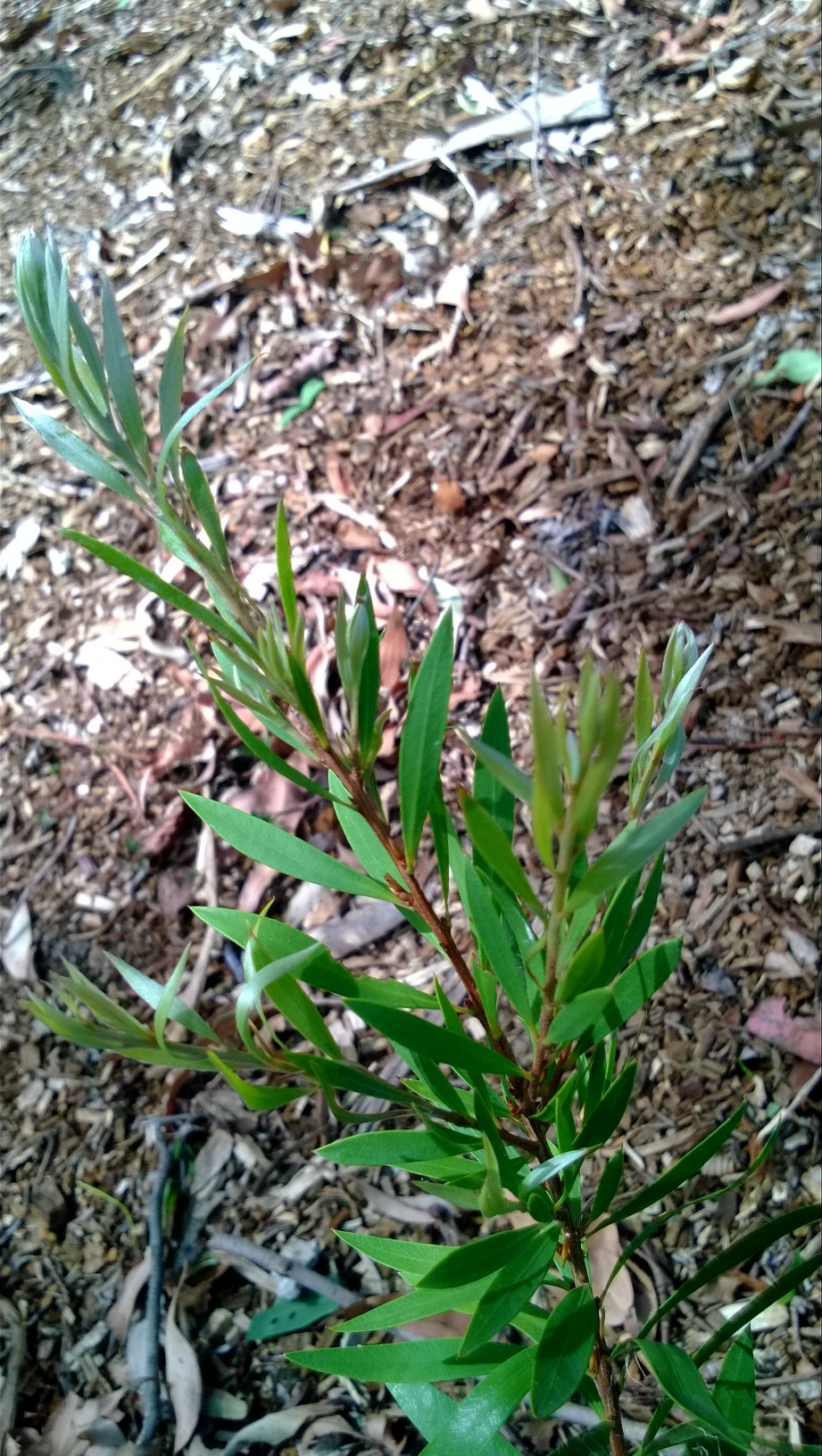
New growth on Bottle-brushes

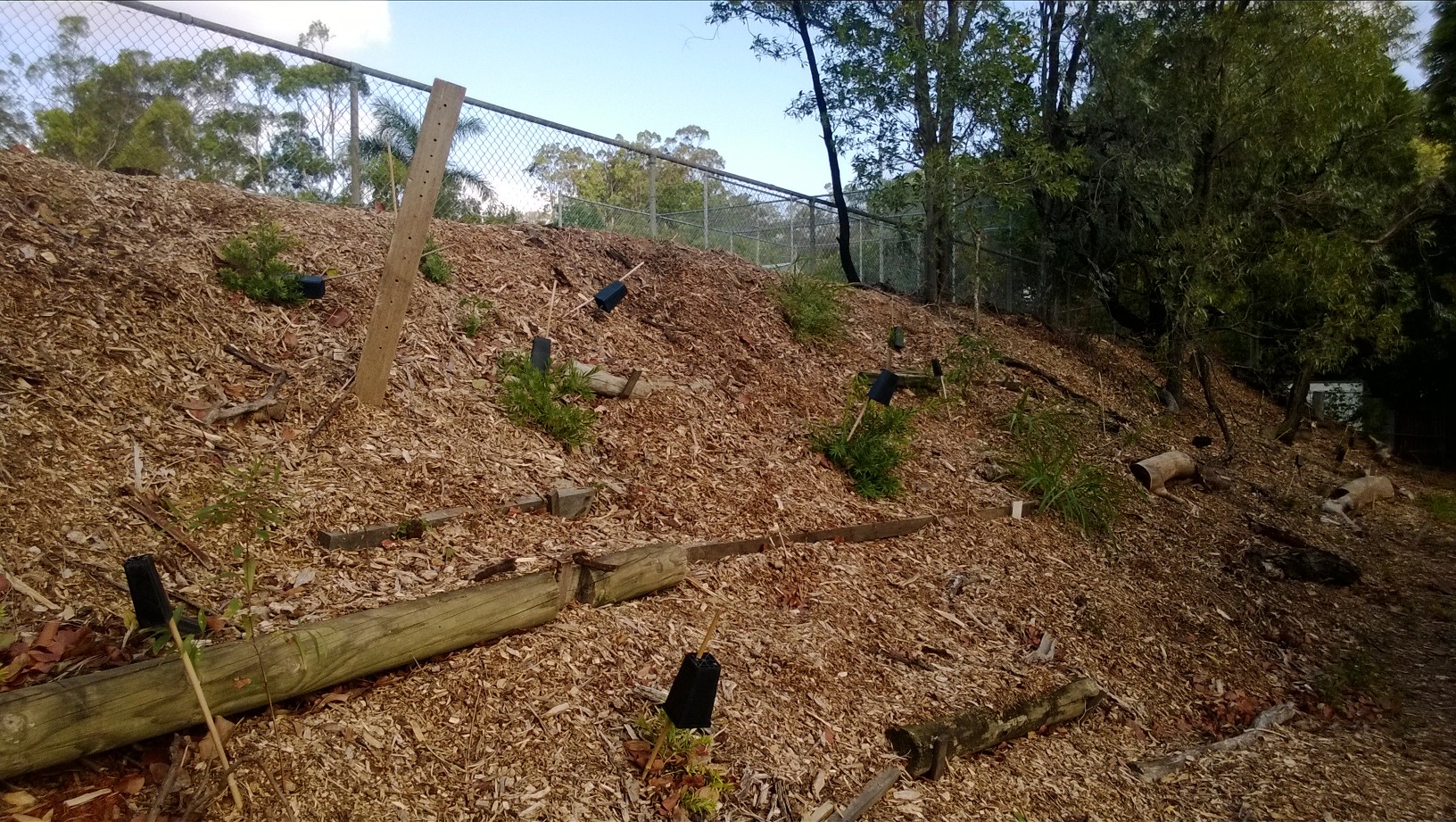
The Pollinator Link garden Mount Gravatt State High School welcomed the cool change that came with the enormous and fierce storm that hit South-East Queensland this week. Heavy rain came with it, which the plants and animals were crying out for. We had been waiting for this rain for a reasonable amount of time, and to prepare the site for the summer wet, most of the soil was covered with a healthy layer of stunning mulch.

WP_20140107_005

Site 1. Looking a lot like a thick weedy jungle, however, all natives, and the invertebrates are loving it.

WP_20140107_004

Cadaghi is very resilient, like this one with new shoots after being cut and poisoned

The Pollinator Link garden suffered, like most things, during the period of extreme heat and blistering sunny days. Yet, there were only a few fatalities, and many plants pushed on. The plants reacted almost instantly to the downpour we had, such as Bottle-brushes producing new soft growth.

Site 1, being the most established, is a great example of what the entire link will eventually appear like. The small area is thick and dense due to the astounding growth of the Scented-top Grass Capillipedium spicigerum, as well as, lush new growth from the Brisbane Wattle Acacia fimbriata. There once was about a dozen Black She-Oaks Allocasuarina torulosa here, however, all but one died, possibly some root disease…

In terms of invasive plants, there are only two ‘hard-to-tackle’ species. There is a large Mother of Millions Kalanchoe delagoensis, population, which over time will be controlled. Probably the most difficult plant is the dreaded Cadaghi tree Corymbia torelliana, growing into massive trees which are also a large problem for our native bees. Yet, over time, these species will be controlled, and the Pollinator Link will be home for a countless number of plants and animals.

Posted in Pollinator Link, Wildlife Corridor | Tagged , , , , , , | Leave a comment

Christmas in Fox Gully

Creating shelter for safety and breeding can make your backyard very attractive for both birds and our fascinating Sugar and Squirrel Gliders.

Mt Gravatt Environment Group's avatarMount Gravatt Environment Group

By: Jude Fox

On Christmas Day we noticed Kookaburras making regular visits to a nest box installed for Boobook Owls. Observing from the bush track, we watched as a parent Kookaburra landed in the entry of the nest box and heard a great chattering from inside as the parent bird’s head disappeared from view.

Later, using the go pro camera we were able to observe four Kookaburra chicks inside the nest box. Inspired by this finding, on Boxing Day we decided to investigate all the other nest boxes we had installed in the gully. This yielded three Glider boxes containing Gliders and two boxes containing Possums. The Possums were in a box intended for Pale Headed Rosellas and Kookaburras, proving that Possums don’t read nearly as well as do Gliders!!!

Including the nest box that the Lorikeets have used to hatch at least three clutches of chicks that we know…

View original post 23 more words

Posted in Pollinator Link, Wildlife Corridor | Tagged , | 1 Comment

Three Easy Steps to vibrant backyards

By: Michael FoxPollinator Link flyer front

Our new Pollinator Link flyer is now available and printed copies will be available.

For copies of the flyer email Pollinator Link Project Manager: Sandra Tuszynska – pollinatorlink@gmail.com

You are free to print, copy or distribute this flyer without alteration. All images on this website are available for use under Creative Commons copyright. The Pollinator Link logo is covered by copyright and trademark protection.

Posted in Bushcare, Mt Gravatt Conservation Reserve, Mt Gravatt Environment Group, Pollinator Link, Wildlife Corridor | Tagged , , , , , , , | Leave a comment

2013 Community Gully Day

Mt Gravatt Environment Group's avatarMount Gravatt Environment Group

By: Michael Fox

2011 Our first Community Gully Day, two years ago, saw the removal of six cubic metres of rubbish, poisonous Yellow Oleander Thevetia peruviana and Madeira Vine Anredera cordifolia, stabilised the banks with logs leaving the ground bare and storm water pipes a visual blight.

d

d

d

d

2012 Between Gully Days restoration work continues with regular Tuesday Bushcare events. Mirandha, Griffith University Bushcare Club, feeds Chinese Elm branches into out chipper.

d

d

d

d

Coin-spot Treeferns Cyathea cooperi are thriving, bush foods like Native Mulberry Pipturus argenteus will growing and the storm water pipes are disappearing under branches creating ideal habitat for lizards and improving visual amenity.

d

d

d

d

d

d

d

d

d

2013 8am The team getting to work, Scott, Barry, Carol, Don and Marshal in background, with Matt and myself delivering hollow logs for habitat.

Note the amazing…

View original post 702 more words

Posted in Uncategorized | Leave a comment

Gift of logs and mulch for high school site

WP_20130624_013[1]

Plantings of natives grasses condition poor soil

By: Michael Fox

WP_20130624_009[1]

Logs keeping mulch on slope

Dale at Climb n Grind is a generous supporter of our restoration work including the Pollinator Link project at Mt Gravatt State High School.

Project Leader, Sheamus O’Connor, sent these photos of the latest planting with mulch and logs gifted by Climb n Grind.

A combination of native grasses and mulch to retain water will condition soil that has been compacted and degraded.

Vibrant soil is crucial to plant health. Soil microbes have a symbiotic relationship with plants – plants provide sugars to microbes and microbes make nutrients bio-available for plants. So by nurturing soil microbes, plants are nurtured, and nutrients and water become available to plants. 

Plants produce complex organic molecules like sugars which they exude from their roots to encourage the microorganism populations that comprise a healthy soil. In turn, micro-organisms, by way of their complex ecology, release minerals that are already in the soil so that they are bio-available to plants. Microorganisms such as fungi with their extensive network of filaments, deliver water and nutrients from a wider area than the plant roots cover. These symbiotic relationships between microorganisms in the soil and the plants above are natural processes and will maintain themselves, provided they are not destroyed by excessive chemical or mechanical disturbance.

Healthy Soils Australia

Posted in Bushcare, Mt Gravatt Environment Group | Tagged , , , , | Leave a comment

Koalas and Flying Gardeners?

By: Michael Fox

After my Cubs in Mud post two weeks ago I received this comment from a local environmental professional:

“Hi Mike, You could include our long range pollinators, flying foxes and lorikeets in anything about pollination as these are our primary pollinators in Australia and are going to play a far bigger part in species ability to cope with climate change compared to insect pollination.”

While I agreed with the point, I really thought this was too contentious an issue for our group to take on. So I was very pleased when Jerry Coleby-Williams last night introduced the Gardening Australia audience to one of Australia’s most important pollinators … fruit bats or flying foxes. Jerry refers to these fascinating mammals as Flying Gardeners because of their vital role in pollinating our native trees and keeping our forests healthy. As bat carer Denise Wade tells Jerry in the segment:

‘No bats, no trees; no trees, no koalas’

Fruit bats in our gardens eating our pawpaws?

Denise and Jerry show us simple ways to protect our fruit trees without hurting bats or birds.

The Wildlife Friendly Fencing Project also has plenty of information and videos for the DIY gardener.

Why wildlife friendly netting?

Posted in Pollinator Link | Tagged , , , , , , , , , , | Leave a comment

GrowsAtGriffith grows fast on iPads around Australia

Mt Gravatt Environment Group's avatarMount Gravatt Environment Group

By: Michael Fox

The invitation said business casual, however, it is a university …

… and these green leaves gathered around Vice Chancellor Prof. Ian O’Connor are justly proud to launch this year’s must have App – GrowsAtGriffith.

Primary and secondary teachers, kindergartens, bushcare group members, local government teams, libraries, anyone interested in Australian native plants should download this App today. It’s free but looks and works like a million dollars.

Mt Gravatt Environment Group provided many of the 500 plus photos on this first release of this excellent tool. So I was proud to represent our group at this launch and finally meet the two key drivers of this project – Assoc Prof Catherine Pickering, Griffith School of Environment and post-graduate student Mark Ballantyne.

a

a

a

img057

View original post

Posted in Uncategorized | Leave a comment

Cubs in Mud – Backyard Beehomes

By: Michael Fox

References and Links

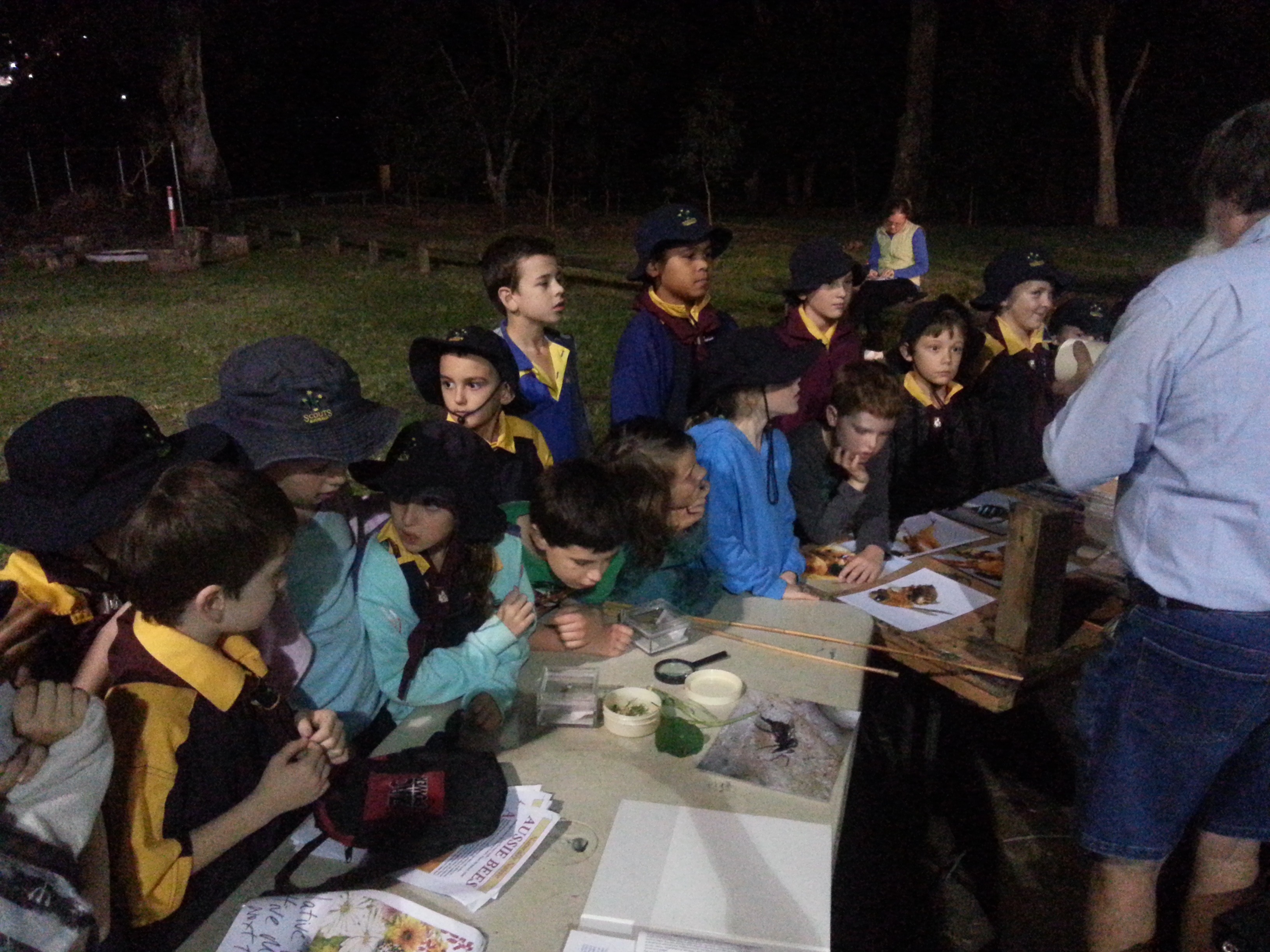
“Seeing the kids having fun took me back to my time as a Cub and Scout Leader. Things have changed a bit since then. There are girl Cubs now and next week they are doing something with computers! Very different but great to see the kids having fun.” I was talking with Len Kann, a member of Mt Gravatt Environment Group, passionate advocate of our Australian native bees and long time Sugarbag Stingless Bee Trigona sp. keeper. Len was helping Cubs, and some Dads, at the Majestic Park Scout Group make backyard beehomes.

We have over 1,500 native bee species most of which are solitary species that do not form colonies like the Sugarbag Bees. In Mt Gravatt Conservation Reserve we have identified Blue Banded Amegilla cingulata, Teddy Bear Amegilla sp. and Leaf-cutter Bees Megachile sp.

Len with his fascinated audience

Len with his fascinated audience

Native bees provide valuable pollination services for agriculture – Sugarbag Bees are valuable for a couple of Queensland favorites, macadamias and watermelons, while Blue Banded and Teddy Bear Bees provide important buzz-pollination services for tomatoes and eggplants in our backyard veggie gardens. Blue Bandeds and Teddy Bears lands on the flowers, disengage their wing muscles, then use these powerful muscles to shake the pollen out of the flowers. While this can be done by wind a good community of native bees provides a much more reliable pollination service to improve crop production.

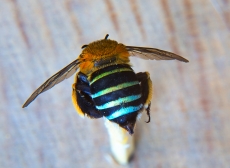
Blue-banded Bee  Photo: Alan Moore

Blue-banded Bee
Photo: Alan Moore

Backyard beehomes provide important shelter and breeding places to attract our solitary native bees to our backyards. Blue-banded and Teddy Bear Bees like to borrow into earth banks to make a nest that they fill with pollen and lay their eggs ready for new bees to hatch out in spring ready to pollinate our veggies.

r

d

Teddy Bear (native) Bee 2 - Alan Moore - 3 Apr 2013

Teddy Bear (native) Bee
Photo: Alan Moore

d

Len’s Cubs in mud were making Blue-banded and Teddy Bear beehomes sieving, mixing and stuffing mud into short lengths of pvc pipe.

d

d

d

d

Leafcutter activity Native Ginger - 4 May 2013

Leaf-cutter Bee action on Native Ginger

While Len was working with the Cubs in Mud the Dads were using their electric drills to make beehomes of Leaf-cutter Bees by drilling different sized holes into blocks of hardwood that can then be hung in trees in the backyard.

Female Leaf-cutter Bees cut circular sections out of leaves on Native Ginger Alpinia caerulea. She then rolls these sections between her legs and flies off to a suitable nest hole in a tree or a bit of carpet like our cat’s scratching post.

Posted in Bushfood, Mt Gravatt Conservation Reserve, Mt Gravatt Environment Group, Pollinator Link, Wildlife of Mt Gravatt Reserve | Tagged , , , , , , , , , | Leave a comment

Gliders in urban space and Camphor Laurel – a useful weed?

IMG_2746

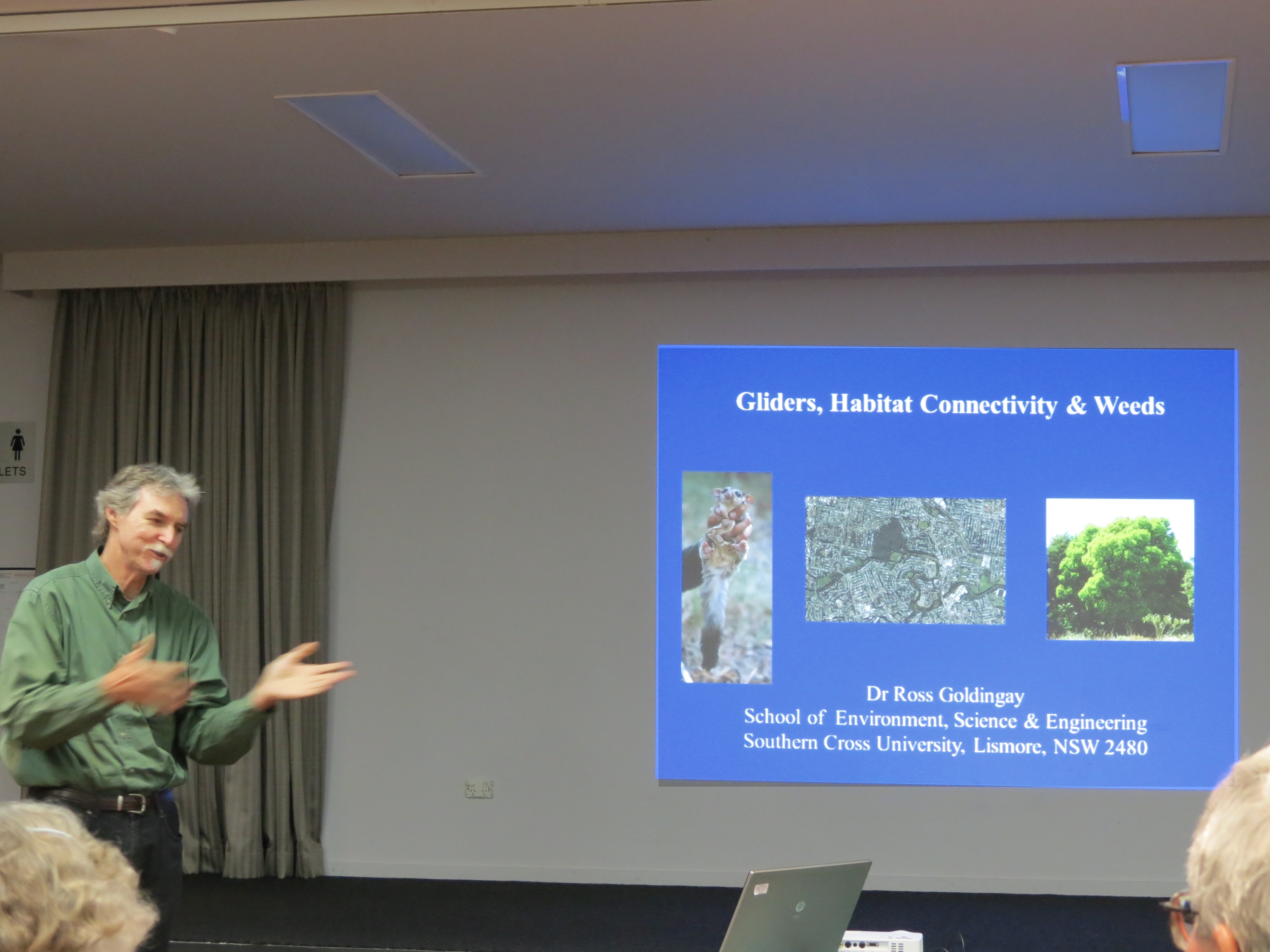
Dr Ross Goldingay  on Gliders and habitat fragmentation

By: Michael Fox

At the March Habitat Brisbane Citywide Meeting Dr Ross Goldingay shared valuable insights into fragmentation of Glider habitat in urban areas and Professor Carla Catterall showed us how the unloved Camphor Laurel can be a valuable friend in forest restoration.

Glider cat attack - Feb 2013

Glider victim of domestic cat attack – February 2013

Ross has used Squirrel Gliders to model the impact of habitat fragmentation caused by the urban matrix of houses and roads in Brisbane. Genetic evidence collected at sites isolated by the Gateway Freeway showed no interbreeding, while sites even a narrow link between two sites allowed interbreeding, that is, Gliders were successfully moving between habitat remnants.

Ringtail on rope bridge

Ringtail Possum on rope bridge – Goldingay

I was particularly interested in these results both Squirrel and Sugars Gliders are found in Mt Gravatt Conservation Reserve.  Lindenmayer and Fischer(1) describe Isolated bushland remnants as island habitats while Tallamy(2) states that “Tiny habitat islands have high rates of species extinction.” Increased species loss in isolated patches of bushland comes through predation (foxes, domestic cats) or bushfire. One Sugar Glider has already been killed this year by a domestic cat in Mt Gravatt Conservation Reserve.

Wildlife corridors

Fox & Firefly Gully wildlife corridors

Ross’s research showing regular use of glider polls and rope crossings by gilders and possums gives me hope that building links through the urban matrix is feasible. Linking wildlife corridors down Fox and Firefly Gullies with Mimosa Creek across Klumpp Road may be simpler and lower cost than I expected.

Ross has generously provided a copy of his presentation – BCC_HabitatBrisbane_Goldingay

Novel ecosystems case study – camphor laurel regrowth

Carla at Citywide - 18 Mar 2013

Carla Catterall is passionate about our bushland

Professor Carla Catterall’s presentation showed us novel approaches to forest restoration that can inform our Bushcare activities.

Reforestation consists of:

Spontaneous (passive) regrowth
• establishes without assistance;
• low-cost
• can be slow

Active planting
• seedlings actively planted;
• done for various reasons;
• higher cost;
• faster initial establishment.

Our love-hate relationship with Camphor Laurels in Fox Gully means I was particularly interested to hear that there may be another way of looking at these environmental weeds. Carla’s presentation challenged us to consider novel ways to make use past human environmental impacts to facilitate reforestation, with the key message “keep an open mind.”

The Camphor case study of the “Big Scrub” in northern NSW, originally a 750sq km rainforest (c. 1800),  shows that in 1958 less than 0.1% remained uncleared. In 2004, 25% of the area was forest regrowth dominated by Camphor Laurel, introduced from China.

I, like most people, thought of Camphor Laurel as major environmental weed, a high priority for removal. However, this is a good example of the importance of Carla’s “keep an open mind”.

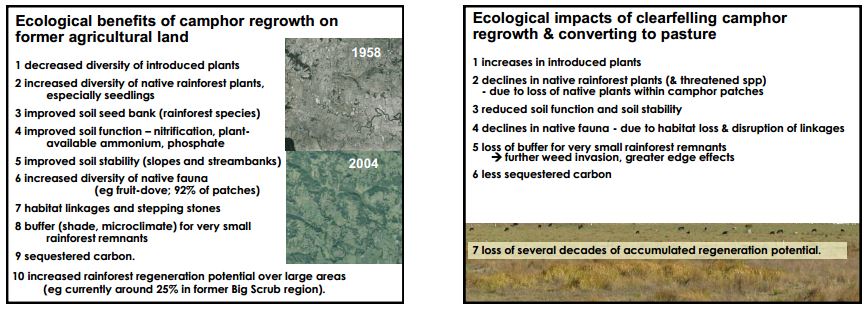
Research of the value of Camphor Laurel (summary of presentation slides):

Is Camphor regrowth desirable reforestation or undesirable weed invasion?

(Survey of plants and fruit eating birds in 24 camphor patches >3 ha)

Camphor regrowth used by:

          34 species frugivorous birds:

          10 high quality seed-dispersers; and

          regionally threatened Rose-crowned Fruit-dove found at 92% of sites.

Camphor regrowth canopy actually supports rather than suppresses native plant regeneration.

Camphor regrowth promotes recovery of soil properties in former pasture areas.

s

Carla C slides - March 2013

Reforestation using Camphor regrowth vs clear-felling Camphor regrowth

Certainly a different way of looking at a despised environmental weed … Keep our minds open.

Thanks to Carla for sharing a copy of her presentation Catterall BCC Habitat Brisb talk_web publish Mar13

Posted in Bushcare, Mt Gravatt Conservation Reserve | Tagged , , , , , , , , | 2 Comments